Clarity data Quality Assurance (QA) process
Accurate air quality data starts with good calibration. This article explains why calibration matters, the two ways Clarity calibrates your Node-S, and how performance is monitored over the life of your project, so you know what's behind the numbers you're acting on.
Why calibration matters
Calibration is what makes your measurements reliable enough to act on. It minimizes measurement errors and brings your sensor readings in line with reference instruments. Calibration performance metrics also let you estimate measurement uncertainty, which is useful throughout your data analysis.
Two pollutants need calibration for different reasons:
- PM2.5: the Node-S uses a laser-based sensor that counts and sizes particles rather than measuring mass directly. Calibration estimates PM2.5 mass concentration accurately by accounting for the particle composition at your site.
- NO₂: the Node-S uses an electrochemical cell (ECS) sensor, which can be thrown off by temperature and humidity changes that shift its baseline. Calibration corrects for these interferences so the raw signal aligns with reference instruments.
The two calibration strategies
Clarity uses two approaches:
- Global Calibration: preset on every Node-S, developed from millions of collocated measurements worldwide. It corrects for environmental factors like temperature and humidity, and is especially valuable if you don't have access to a reference monitor.
- Collocation-Based Calibration: tailored to your local conditions for the highest accuracy. You place your Nodes next to a reference monitor for at least a month before deployment. Clarity evaluates that data, and if Global Calibration doesn't meet performance expectations, develops a custom calibration.
Preset Global Calibrations
Every Node-S ships with two preset calibrations: the PM2.5 and NO₂ Global Calibrations. These were built by collocating Clarity devices with reference monitors across a wide range of conditions: 6,000,000+ collocated measurements from 450+ sensors in 45+ cities.
- The preset PM2.5 calibration minimizes errors in the optical particle counter's estimate of aerosol composition.
- The preset NO₂ calibration uses advanced statistical methods to counteract the temperature and humidity fluctuations that affect the ECS sensor's baseline.
These calibrations significantly improve on raw sensor data, and your raw data is always available alongside the calibrated measurements. Clarity still recommends collocation-based calibration for the best accuracy and to quantify each Node's performance.
So you know: If you don't have a reference monitor and choose not to collocate, we'll explain the limitations that come with calibration-without-collocation. If you get access to a reference monitor later, retroactive calibration can be performed.
Collocation
Collocation means installing your Nodes right next to a reference monitor so both are exposed to the same pollutant concentrations. It serves two purposes:
- Developing custom calibrations: all Nodes are deployed next to a reference monitor in your project region for at least one month before field deployment. The collocation data has to meet requirements for pollutant concentration range and for temperature and humidity range, and you can see the full requirements in how to collocate your device.
- Monitoring long-term performance: Clarity advises keeping at least one Node permanently collocated with the reference monitor for the whole project.
Custom collocation-based calibrations
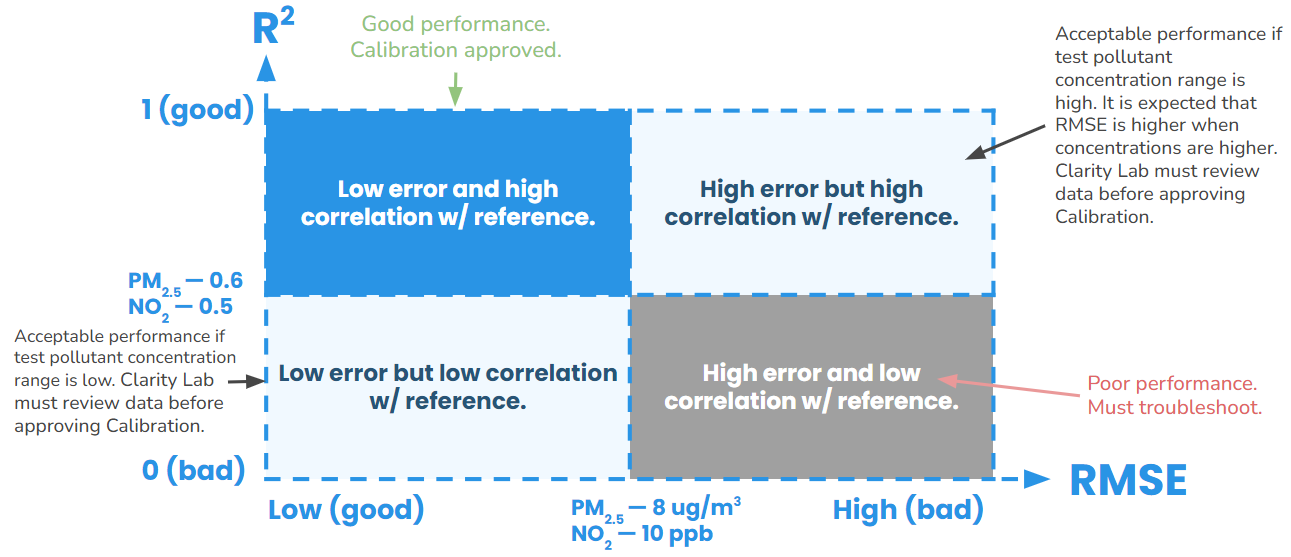
Collocation data tells Clarity whether the preset calibrations are good enough for your site. If the preset calibrations meet predefined performance standards, they're validated for use. If they fall short, the collocation data is used to build a custom calibration: a regional model for PM2.5, or sensor-specific models for NO₂.
During this process, each calibrated Node's measurement performance is quantified using a portion of the collocation data set aside for evaluation. These performance metrics give you added assurance of accuracy and help quantify uncertainty during analysis.
Long-term performance monitoring
A Node's performance metrics hold true as long as it operates in the same environmental and pollutant conditions it saw during calibration. To keep an eye on this, Clarity advises keeping at least one Node permanently collocated with the reference monitor for the duration of your project.
That long-term collocation data is available through the Clarity API and in collocation-focused sections of the Dashboard. If a Node's performance drops below its calibration levels, contact support@clarity.io, and Clarity will review the data and advise on a recalibration or device replacement.
What's next
Still need a hand? Email us at support@clarity.io or create a support ticket, and our team will get back to you.
Was this helpful?